 Ancient Masters
HomeSchoolMagus OrderLibraryPodcastArtefacts
Ancient Masters
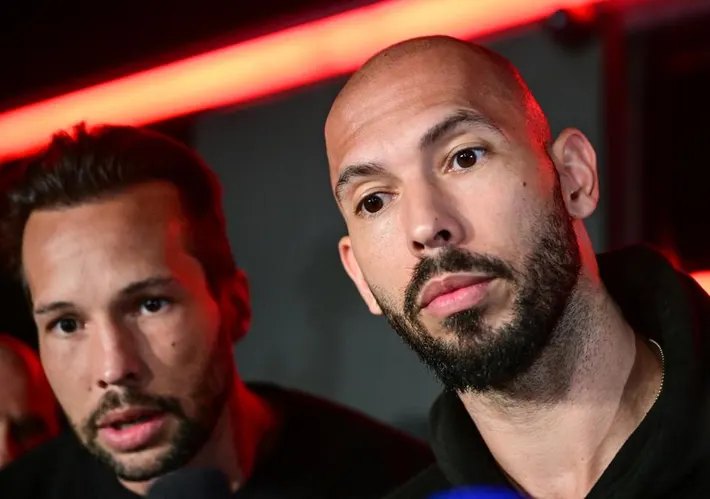
HomeSchoolMagus OrderLibraryPodcastArtefacts Whether Andrew Tate or Tristan Tate is guilty is a question several courts are working on. Tate brothers built an audience of millions on a specific claim that dominance over women, a high count of sexual conquests, and visible spending prove masculine power.
Sexual Energy and Yang
Sexual energy is a resource to cultivate and direct with consciousness. In our book, there are two pitfalls: suppressing the energy through asceticism, and being consumed by it, the pattern the book associates with Aleister Crowley’s sex magic.
The second energy center, Svadhistana, has yin and yang parts, and it is where sexual energy is exchanged between a man and a woman. With improper partners, or partners changed too often, the center cannot adapt to a harmonious exchange; it wears down and is eventually damaged.
The book also dedicates an entire chapter to what it calls false attainments — signs a student mistakes for real progress when nothing real has happened. A stomach that has grown is read as a “developed lower dantien,” and a feeling of being different is read as spiritual opening. The chapter’s function is to warn students that a display can be mistaken for a result, and that the mistake is common enough to name and catalog in advance.
The Tate Model
Set the Tate persona against that teaching. Andrew Tate’s published description of his business is that his job was to get women to fall in love with him so they would do what he said, then move them into work that generated income for him. His course material coached followers to project mystery and status through curated online messaging, to treat a high count of sexual partners as a measure of a woman’s worth, and to display wealth — private jets, luxury cars — as the visible proof of the whole system working. We call this fake yang: dominance performance, conquest-counting, and conspicuous consumption, marketed as masculine power by feeding the insecurities of the young men who buy it.
Tate set out the same model in a three-hour interview with the Jack Neel podcast, recorded in May 2026 and released the day after the brothers’ arrest in Miami. Looking back on his life, he listed what he has had: “Bugattis, private jets, the most beautiful women on the planet, endless children, endless money, fame, most famous man in the world, a fighter, a chess player. I’ve done everything.” He summed up the message he gives young men as “Go to the gym, stick up for yourself, get a Bugatti, be a man, work hard.”
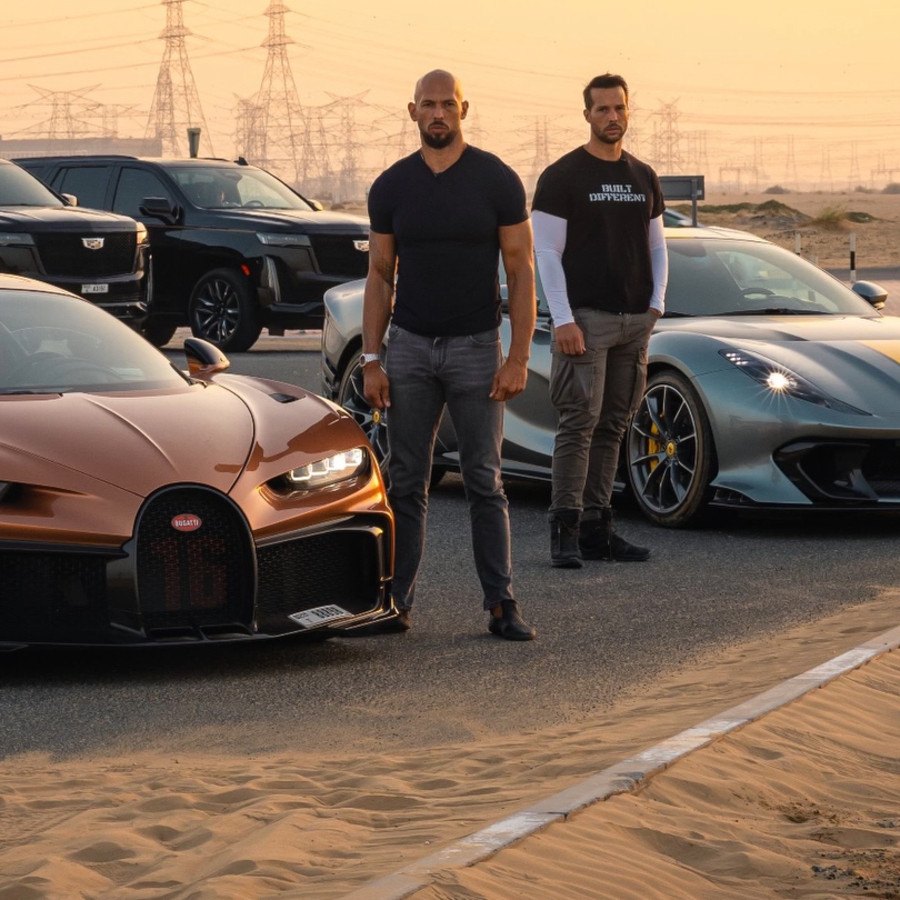
In Tate’s book, what counts is purchases, women, and fame, and every item on it is something acquired or shown to other people. Nothing on it was gathered in private. In our view, the list is a complete inventory of fake yang, and his advice to young men places a Bugatti beside the gym and hard work as though the car belonged to the same discipline.
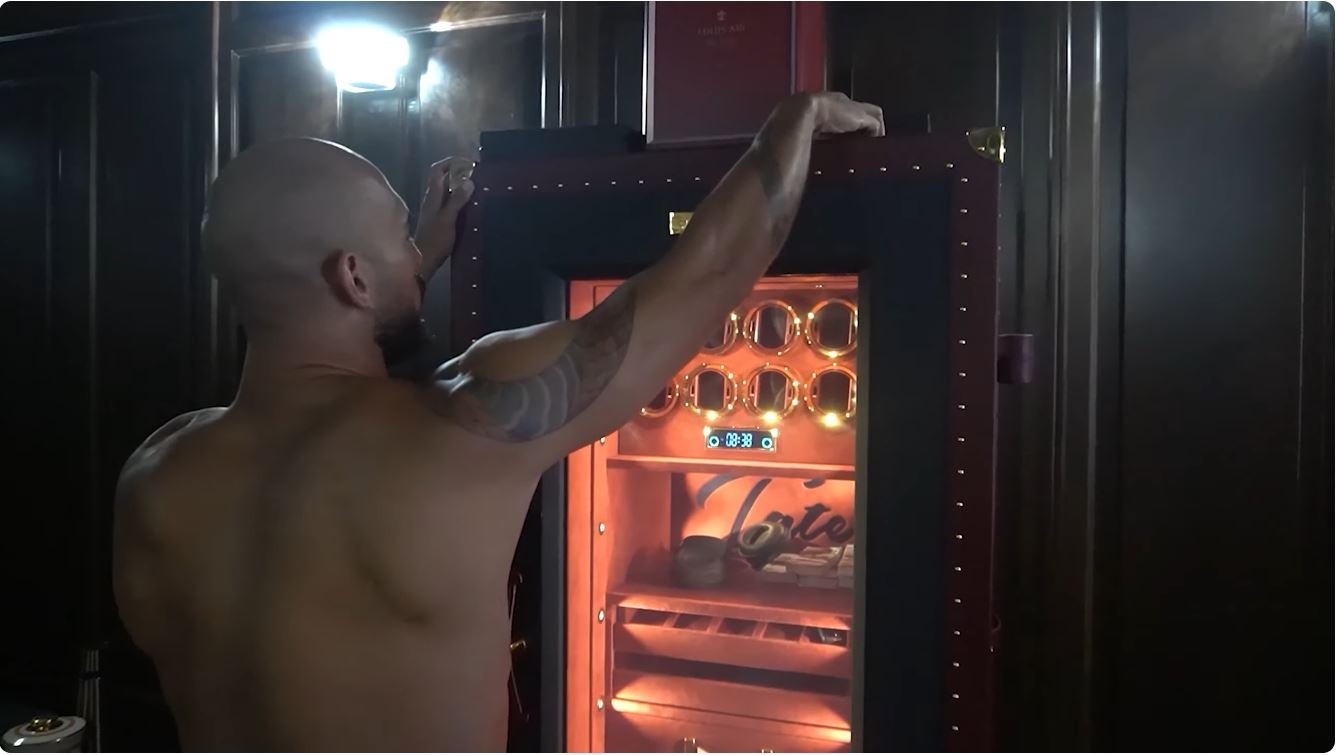
The interview also shows display used as a message to the authorities. When a period of house arrest ended, Tate says, “my brother and I got a brand new Porsche GT4 RS and a McLaren 765 LT in purple delivered to our house.” While a prosecutor was asking where the brothers’ money came from, he says, they were “buying a new car every day just to piss him off.” He also describes a police search of his house in Romania, where the officers found a safe he had designed to be looked at: “so sometimes we do silly things like show off, and I had a safe with bulletproof glass at the front so you could see all my nice things. You could see all the watches, see the piles of cash, see the gold.”
A safe exists to hide what is valuable. Tate had his built with a window so that anyone in the room could see what was inside. In our judgment, the safe and the cars follow one rule: his possessions serve him as messages to an audience, whether that audience is his followers or the prosecutor on his case.
What They Teach
Behind the persona sits a paid product. The test for any paid curriculum is whether it delivers what the marketing promises.
Tate described the promise behind the school in the Jack Neel interview. He presented it as an alternative to traditional education, which he called a waste of time, and named what customers want instead: “People want money. They don’t want a degree. They don’t want to go and study for four years. They want money. They want it today.” He then described the division of work he proposed to the friends who would run the courses: “I’m going to do the big mouth at the front of it. I’m going to use my wealth and my influence to attract people to this school, and you’re going to do five or six hours a day of live calls and convince people and show people how to make money online.” The promise is money on the day of purchase. The sales tool is the founder’s displayed wealth. Neither statement mentions a standard or a period of study.
Hustler’s University and The Real World. Tate’s subscription program launched in 2021 on Discord at $49.99 a month, organized into “Campuses” covering e-commerce, copywriting, crypto and stocks, freelancing, and Amazon FBA-style reselling — a menu of generic online-hustle topics available from many cheaper or free sources. The program’s growth past 100,000 members came from its affiliate structure. In a course called Affiliate Marketing, members were promised half of a new recruit’s first month, roughly $25 per signup, for posting Tate clips and bringing in new subscribers. Journalists and independent investigators concluded that recruiting more subscribers, more than applying any of the taught skills, was the most reliable way to profit inside the program.
Coffeezilla, an investigative YouTuber who joined the program, used two different labels for that structure. In his first video on it, he described the flood of affiliate clips and paid-for reviews as “this pyramid scheme.” Later, on the Lex Fridman Podcast, he drew a narrower line: what Tate sold was “not multi-level marketing” but “an affiliate marketing thing, which is slightly different.” An affiliate earned once from each person he signed up and nothing from that person’s recruits, while Tate, he said, “in perpetuity makes $50 a month off of you.” When Fridman asked whether the scheme had “some fraudulent aspect,” he said he thought it did.
Meta and TikTok banned Tate in August 2022. The next day Hustler’s University closed its affiliate program, saying it had “no future”; the commission had already fallen to 10 percent. The underlying product reopened that November under the name The Real World, on the same platform, with the same campuses and the same $49.99 monthly fee.
Tate tells the story of that growth as an invention: “When we came up with the affiliate marketing campus, we invented clipping. We ruined the internet.” Members took his videos, posted them on their own channels, kept the view money, and earned commission on the subscriptions they sold, until the school reached, he says, 271,000 students. He describes a fast start: “Within the first week, we had 25,000 paying students.” Tate’s figure for a single week is about twice the subscriber count reporters found in March 2022, months after launch, and his peak is higher than any count published for 2022. The tracked numbers do support one part of his story: membership grew while affiliates were paid to recruit, and it fell after the affiliate program closed and his accounts were banned.
Tate also described what the affiliates learned to post. They “worked out that they make the most money if they put up the most controversial clips of me,” he said. His example was a clip about threatening a woman with a machete; affiliates cut it down to its last line and posted that part alone “because that gets the most engagement. That goes the most viral. They get the most sales.” When Tate told his brother that the students were making him look bad, he says Tristan answered, “We’re making $10 million a month,” and then, “Bad guy, good guy, what does it matter?” The $10 million is Tate’s figure; reporters estimated the program’s revenue at over $11 million a month by late 2022.
The clips that sold the school best were his most provocative ones, and the affiliates kept the arrangement because it paid. In our view, the skill the program trained most widely was the one it paid for: cutting and posting the founder’s most provocative moments for commission. Tate made his students work hard to promote his school; that was the best chance they had to earn some income, too. It’s very similar to vendor financing model seen today in AI compute.
Tate rejects the description of the school as a scam. “It wasn’t a scam,” he said in the interview. “The reason it worked is because it worked. If it was a scam, it never would have took off.” In a 2022 interview with the Mirror, the brothers described their webcam business in Romania as a “total scam” that used cam models to get men to send them money. The two statements concern different businesses. The argument for the school is circular, since it offers the sales as the proof of the product. The man making it has called one of his own businesses a total scam, and he asks the customers of the next one to take his word that it is sound.
The lessons. Tate taught little inside the campuses. His contribution was a series of “100 business lessons,” which later leaked: general maxims with no step-by-step method. In lesson 51, he asks why you run your business and answers, “for money.” Reviewers say that after the opening videos, Tate was rarely present; “once you join the university you barely see tate at all,” one of them said.
Coffeezilla, the program’s best-known critic, made the strongest case he could when Lex Fridman asked him for one: “some people in order to make a change in their life need a someone who they can look up to and men don’t have a lot of like strong role models.” He then said his case “has to stop there,” because he disagrees with the values Tate pushes. His view of the lessons in the same interview was short: “Behind the paywall, it’s nothing of substance.” Members who left the program reached a similar view. Jack Persey, who tried the copywriting course and later canceled his subscription, told a reporter, “This is all information I could have found in a YouTube video.” A former member who spoke to Vice called the material “very, very basic stuff that was not worth the money, and definitely not $50 a month.”
The professors. Tate’s marketing said every professor was “hand-selected from my private War Room network, every one of them I have verified to not only be a millionaire, but to have made their millions using the methods they teach you.” The professors had “all seemingly chosen to hide their appearance either through their name or avatar”: one used a cartoon monkey as his avatar, another Pepe the frog. The more specific claim that every professor “has earned over $1 million” appears on unofficial promotional sites. A critic who looked some of them up found that some had “launched like scammy crypto coins,” and that the crypto professor had promoted coins “that did bad and then like deleted the tweets.”
Prices and refunds. The price started at $49.99 a month. The terms of use state: “Except where required by applicable law or expressly stated otherwise, Subscription fees are non-refundable.” Any other refund is at the company’s discretion. The same terms say that the company “does not guarantee that use of the Subscriptions will result in any particular financial, business or commercial outcome.” According to Vice, the platform’s marketing told recruits they could earn “over $10k per month quickly.”
Platform actions. Stripe stopped processing the program’s payments in the summer of 2022. It did not explain the decision, and Dexerto noted that its policies bar “get rich quick schemes.” Google removed The Real World app from Google Play in 2023, after Vice asked about a campaign that called the app a pyramid scheme. In 2024, YouTube terminated a number of The Real World channels, among them one with more than 600,000 subscribers and 450 million views, for “prominently featuring content from a previously terminated user,” a YouTube spokesperson told Vice. In the public sources we searched, we found no reported action by a consumer regulator over the courses or the affiliate scheme, and no reported lawsuit by students.
Coins. Outside the campuses, Tate promoted coins to his followers. DADDY, a memecoin, was issued in June 2024, and 40 percent of its supply was sent to Tate’s account, according to the blockchain analytics firm Bubblemaps. Tate promoted it on X, and within three days it reached a market value of about $240 million, CoinDesk reported. Bubblemaps also traced 11 wallets, funded through Binance with nearly identical amounts at the same time, which had bought 20 percent of the supply before the token’s first promotional post, and two other clusters holding a further 10 percent that had also bought before Tate’s first post. The report did not say who controlled those wallets, and CoinDesk found no evidence that Tate had sold. A year later, DADDY had lost more than 88 percent of its value from its peak.
What the lessons were worth. Some teachings were “useful”. A beginner could learn to write to a business and offer a service, to set up a Shopify store, and to open a brokerage account and buy an index fund. Ordinary skills, sold monthly through a display of wealth the skills don’t produce.
The “PhD” course. Inside Tate’s webcam-recruitment program, a course was marketed under the name “PhD” — reported to stand for “Pimpin’ Hoes Degree” — and, per its now-deleted advertising page, promised to “teach you how to obtain and retain unlimited beautiful women” and “turn them into cold hard cash.” Tate’s material, as archived and reported by Vice, described his method: “My job was to get women to fall in love with me. Literally,” followed by a described sequence — meet a woman, date her, sleep with her, “test if she’s quality,” get her to fall in love with him “to where she’d do anything I say,” then move her onto webcam work. The same course materials framed a woman’s loyalty after infidelity as something to be manufactured through psychological pressure.
The War Room. Membership in Tate’s private “War Room” group was reported at around $8,000 a year; a 2026 report put the entry price at $2,400. A 2023 documentary investigation reviewed roughly 12,000 pages of internal Telegram messages among hundreds of War Room members and reported that members were coached by group leaders in what the documentary called the “loverboy method” — simulating a romantic relationship to build emotional dependency and isolate a woman socially before moving her into webcam work — taught in part through the PhD course. The investigation identified 45 potential victims from about one year of the logs alone, noting the true number was likely higher. Romanian investigators have described the same recruitment pattern in their filings, using the term “loverboy method.” Tate’s press office responded to the documentary by calling it “another brazen attempt to present one-sided, unverified” allegations; he has denied wrongdoing throughout.
The Matrix
Tate’s name for the system he says he fights is “the Matrix”, and in the interview the word does two jobs. The first is selling the school. Tate quotes Tristan describing the business as “teaching young men how to escape the matrix and make money.” He presents his school as a rival to universities, which he says trap teenagers in debt: “If I told everyone I went up against big pharma and they came for me, they’d understand it. I went up against big education.” He adds: “The schools use the banks to enslave the populace.” On these terms, a subscription to his school is the way out.
The second job is explaining the case against him. When Romanian police took the brothers into custody in December 2022, Tate said on camera, as guards walked him to a police car, “The Matrix has attacked me.” He says Tristan’s answer to each detention was “It’s a Matrix attack.” He calls the Romanian prosecutor “the attack dog for the Matrix”. He describes the order in which, he says, the system deals with men like him: “First, they try and shut you up,” and then, “Second, you try and put him in jail. Third, you kill him.” He also voices the reasoning he attributes to his enemies when they looked at his past: “We can find something to pin on him.”
Once the Matrix explains everything, no evidence can count against him. An arrest proves the attack. A charge is something the enemy found to pin on him. The prosecutor who files it is an attack dog, and a stronger case shows only a more determined enemy. The same explanation protects the business. A member who paid to escape the Matrix hears each new charge against the founder as proof that the escape was necessary. The Jack Neel interview was made for that use: according to the host’s pinned comment on YouTube, as reported by Mother Jones, it was recorded in May to be released if the brothers were arrested again, and it went out the day after they were.
The Legal Record
As of October 2026, no court has convicted either brother, and both deny any wrongdoing. In Romania, they were first indicted in 2023 on charges including human trafficking and rape; a court annulled that indictment over procedural errors. Prosecutors have since filed a new one, charging Andrew Tate with trafficking of minors, money laundering, sexual activity with a minor, and influencing statements, with Tristan Tate charged as an accomplice.
In Britain, prosecutors charged both brothers with offenses including rape and sex trafficking, and four women are suing Andrew Tate in a civil case alleging sexual violence and coercive control, which he denies. In July 2026, the brothers were arrested in Miami on Britain’s extradition request, and a judge ordered them held without bail while they contest it.
In Florida, the brothers are suing a woman they accuse of giving false evidence to Romanian prosecutors. A judge allowed part of the suit to proceed, and she has filed her own suit accusing them of defamation; her lawyers call the brothers’ suit “blatant witness intimidation.” The state’s attorney general announced a criminal investigation into the brothers in 2025; its status is unclear.
Tate Claims in the Interview
The woman he is suing in Florida. Tate said she “made a false accusation” during a five-day stay in Romania, that she was paid to make it, and that she is the only woman who has ever accused him. He said she had accused her father and ten other men of sexual assault, that she takes psychiatric drugs, and that she has been held in a mental institution against her will. No court has ruled on any of these claims. The judge who let part of his suit proceed cited messages in which she and a friend discussed demanding $200,000; her own suit alleges that the brothers defamed her. Four women bring the civil claim in London.
La Strada. Tate named the anti-trafficking organization La Strada as the source of the payment. He said it paid her $30,000 three days before she first contacted Tristan, paid for her ticket to the south of France and her hotel there after she left Romania, and pays the legal team defending her, which he put at eleven lawyers. “It’s all a setup,” he said. No document supporting any of these claims has been published, La Strada has not responded to them in any reporting found, and public reporting names her counsel as the National Center on Sexual Exploitation. Versions of the claim that circulated online gave the payment as $100,000.
The British state. Tate said that “Great Britain put me on a terror watch list” and that a Foreign Office letter to Romania called him “an unchecked source of influence”. He suggested that before the second Romanian case British officials told Romania, “Make something up and go.” He said that while he was under house arrest he received handwritten letters urging him to kill himself, which he attributed to “psychologists in MI6, GCHQ”, though he also said, “I don’t know they were psychologists but I assume they had to have been.” He described his enemies weighing whether to kill him: “Or does he want to be in a plane accident? Planes crash, bro.” No public document supports any of these claims. He says the letters are kept in a secure location.
His condition. “I got PTSD,” Tate said of the months after his release from jail. Of the years of the case, he said, “I didn’t realize I was mentally unwell until now that I’m relatively free.” He described “only sleeping three nights a week,” and said, “I optimized my mind and my life for resistance.”
His phones. Tate described the morning police came to his house for what he called the third raid. He said he told his partner, “Wipe your phone,” and then, “Laptops. Wipe all our laptops.” Of the household, he said, “We wipe everything.” He said that after police seized his phone in the first raid, Romanian law required him to give its password, and that he told the officers, “I’m sorry, sir. I have forgotten. I don’t remember.” He said he gave the same answer weeks later, after his lawyer and prosecutors had negotiated a written offer of immunity in exchange for access to the phones. No public reporting confirms the offer.
A clip he played. During the interview, Tate played a clip of himself from an earlier podcast appearance, whose original date is unconfirmed: “Having sex was the easy part. That’s when the game starts. Now I need her to quit her job, leave her house, move in with me, work on webcam, do as I say, share me with other women, and give me her money. That’s the hard part.” He played it while describing how, he says, prosecutors decided to “hastily throw this together” from his podcast talk about pimping.
What to Watch For
Our tradition describes real power attainment that is quiet and slow to build; it is hard to fake, and it shows in a practitioner’s conduct. A performance staged for an audience is a different matter, and the louder and more constant the performance of power, wealth, or conquest, the more reason a seeker has to ask what is being built underneath it, and whether the performance is the product or conceals a different one.
All the riches, influence, and fame did not make Tate happy or fulfilled. Near the end of the interview, he describes living with armed security teams around him and says, “This is no way to live. Truthfully, it’s no way to live. The sword of Damocles is far more intimidating than the grapes are tasty.” Tate is the same victim as his students and followers. Having more wealth than others, and power over others, does not bring a person to self-realization. What has driven him is his own insecurity and weakness. In our tradition, the Fifteenth Arcanum describes this state: a person stuck in the quicksand of his own attachments.
Sources
- Jack Neel Podcast, "Andrew Tate's Emergency Interview Before Miami Arrest" (recorded May 2026): YouTube, Apple Podcasts — every interview quotation (from the automatic captions).
- Mother Jones, "Every Time the Tates Get Arrested, Their Media Empire Kicks Into Gear" (2026) — the interview's release plan, the War Room entry price.
- BuzzFeed News, Hustlers University 2.0 (2022) — subscriber counts, revenue estimate, affiliate commission, Jack Persey's quote.
- Business Insider, affiliate program closed, and Dexerto, affiliate program shut down (2022) — the closure, the relaunch as The Real World, Stripe's withdrawal.
- The Tab, "Andrew Tate Hustler's University: What is it and is it worth it?" (2022) — the professors' claimed credentials and avatars.
- Vice, Tim Hume: Google Play removal (2023), a former member's account (2024), YouTube terminations (2024).
- Coffeezilla, "I joined Andrew Tate's cult and it was worse than I thought" (2022), and Lex Fridman Podcast #345 (2022).
- Euro Trades, "Hustlers University LEAKED Lesson 51-62" (2022) — Tate's lesson 51.
- The Real World, Terms of Use — the refund clause and the earnings disclaimer; hustlersuniversityapp.com (unofficial promotional site) — the "over $1 million" professor claim.
- CoinDesk, DADDY early buyers (2024), and Bucharest Daily News, DADDY down 88% (2025).
- NBC News, the webcam business as a "total scam" (2023).
- Vice, "How Andrew Tate Used Tinder and Instagram To Try To Groom Women As Camgirls", and BuzzFeed News, the "PhD" course.
- BBC News, "Andrew Tate: Chats in 'War Room' suggest dozens of women groomed" (2023) — the documentary, the "loverboy method," Tate's response.
- Balkan Insight, the December 2022 detention.
- Romania: Yahoo News, indictment annulled (2024); Al Jazeera, new indictment (2026).
- Britain and the US: Al Jazeera, the UK charges and the Miami arrest; CNN, the custody ruling (2026); PA Media, the UK civil claim.
- Florida: CBS Miami, the defamation suit ruling (2024); NBC News, her suit (2025); CNN, the attorney general's investigation (2025); ProPublica, its status (2025).
- Sportskeeda, circulation of the NGO payment claim (2026).
- Bits of Ancient Knowledge, the school's ebook — false attainments (Ch. 4), Svadhistana (Ch. 7), sexual energy (Ch. 8).